
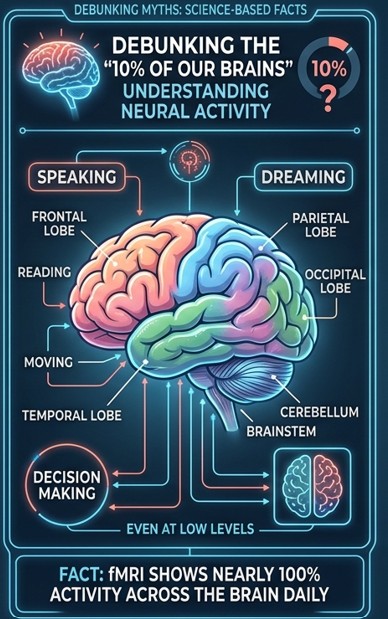
The idea that humans only unlock a meager 10% of their total brain power is a captivating trope in science fiction, often used as a plot device for unlocking psychic powers, limitless intellect, or superhuman abilities. However, in the realm of modern neuroscience, this concept is as mythical as a unicorn. Functional magnetic resonance imaging (fMRI) has decisively proven that we use 100% of our brains over a 24-hour cycle.
This pervasive misconception likely originated from early researchers misunderstanding “glial cells,” which make up roughly 90% of the brain, as “inactive filler.” In reality, glial cells are essential support staff, providing nutrients, insulation, and waste removal. While neurons are the flashing lights of consciousness, glial cells are the entire electrical grid that keeps them illuminated.
Total Activation, No “Dead Zone”:
Today, fMRI and positron emission tomography (PET) scans provide real-time maps of brain activity based on blood flow and metabolism. These scans demonstrate that even during deep sleep, the brain maintains a fundamental level of “resting state” activity, managing vital autonomous functions. When a person is awake, scans reveal complex patterns of activation.
There is no “silent” region of the human brain. While an individual task might not simultaneously ignite every single neuron at maximum intensity, fMRI maps of daily activities (e.g., pouring coffee, reading, speaking, listening to music) show that virtually all structures contribute to these processes. Different regions specialize—the occipital lobe processes sight, the temporal lobe processes sound and language, the frontal lobe handles decision-making—but they are a deeply interconnected network.
The Ultimate Proof: Brain Damage:
Perhaps the strongest evidence against the 10% myth comes from clinical neurology. If 90% of the brain were unused, damage to those vast areas would have zero effect on a person’s functionality. Instead, we know that even micro-lesions (tiny damaged areas) or a small stroke in any part of the brain can result in profound and often irreversible impairments, from paralysis and blindness to the total loss of language (aphasia).