
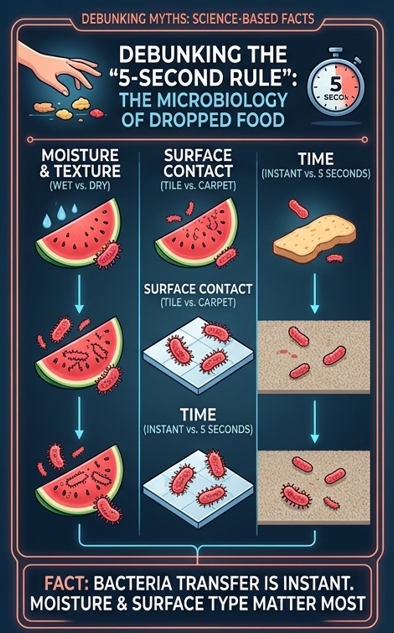
The “5-second rule”—the widely held belief that food dropped on the floor for fewer than five seconds is safe from bacterial contamination—is one of the most persistent culinary myths. While convenient for those unwilling to part with a dropped snack, the idea that bacteria wait a polite amount of time before pouncing on food is a dangerous oversimplification. Scientific investigations into surface-to-food bacterial transfer have definitively proven that contamination occurs instantly.
A seminal study led by Professor Donald Schaffner at Rutgers University found that bacterial transfer to food is a highly complex process influenced by a hierarchy of factors, with contact time often being the least critical. The research analyzed four food types (watermelon, gummy candy, bread, and buttered bread) on four surface types (stainless steel, ceramic tile, wood, and carpet) over four contact times (less than 1 second, 5 seconds, 30 seconds, and 300 seconds).
The most decisive factor is moisture. “Watermelon had the most contamination of any food,” Schaffner concluded. “Bacteria don’t have legs, they move with moisture, and the wetter the food, the higher the risk of transfer.” High-moisture foods create an immediate “highway” for bacteria like Salmonella or E. coli.
The Impact of Surface Texture:
Surface type also plays a critical role. Surprisingly, the Rutgers study showed that carpet had the lowest transfer rate of bacteria compared to tile and stainless steel, counter to public perception. Carpet, with its intricate fibers, has much less actual surface area in direct contact with the food compared to the perfectly flat plane of a tile floor. However, carpet can harbor deeper, harder-to-clean bacterial pockets, meaning while initial transfer may be low, the overall microbial load in the environment is not.
The Bottom Line:
The science is clear:
There is no 5-second grace period. Bacterial transfer can happen in less than one second. The only reliable metric for assessing risk is the type of food and the overall cleanliness of the surface. A dry gummy bear on a recently sanitized kitchen counter presents a very different risk profile than a wet slice of orange on a public bathroom floor. But in either case, the duration of time it spent there is not a safety shield.