
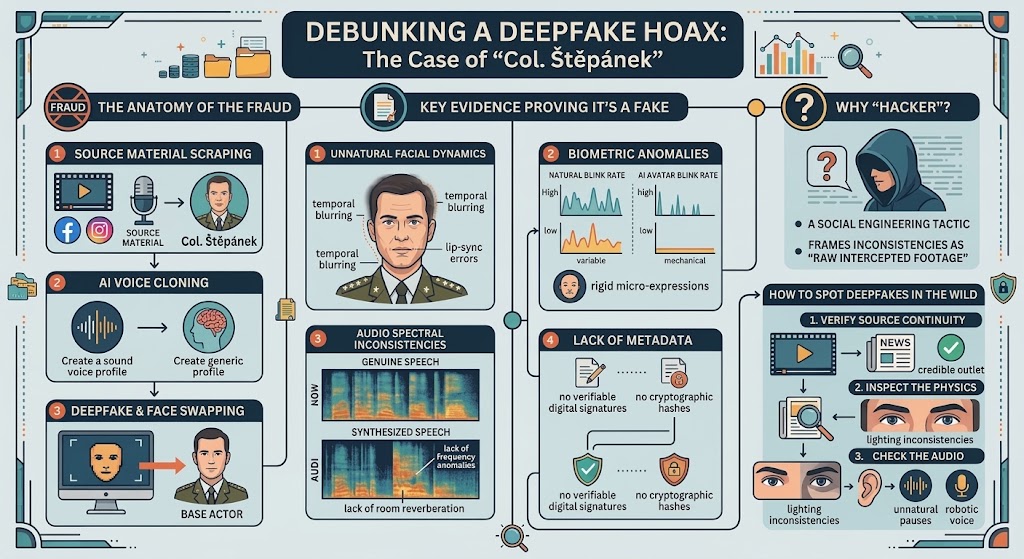
In recent months, a viral video circulated across social media platforms claiming to show a high-ranking military officer—specifically identified as Czech Colonel (plk.) Štěpánek—delivering controversial statements. The creator behind the video, a self-proclaimed hacker, touted the clip as an exclusive leak. However, a digital forensic analysis quickly reveals that the video is nothing more than a cheap synthetic manipulation created using deepfake technology.
Here is a breakdown of how the scam was executed, why the video is fake, and how simple digital literacy tools bust the hacker’s claims.
The Anatomy of the Fraud
The scammer leveraged modern, accessible artificial intelligence tools to impersonate Col. Štěpánek. Instead of breaking into secure military networks or obtaining genuine classified material, the creator followed a well-worn cyber-impersonation playbook:
Source Material Scraping:
The creator harvested public audio and video footage of Col. Štěpánek from official military briefings, interviews, or public appearances.
AI Voice Cloning:
Using generative audio models, the individual trained an algorithm on a few minutes of Štěpánek’s genuine speech to create a synthetic voice persona.
Deepfake Lip-Syncing & Face Swapping:
By applying a neural network-driven face-swap or lip-sync tool to a base video actor, the creator aligned the artificial audio track with modified visual facial movements.
Key Evidence Proving the Video is a Deepfake
While generative AI models are improving, deepfakes almost always leave digital “fingerprints.” Several clear indicators prove this video is artificial:
Unnatural Facial Dynamics and Artifacts:
At high-resolution playback, the boundaries around the subject’s jawline, collar, and hair display temporal blurring and pixel distortion. Lip movements routinely desynchronize from complex consonant sounds.
Biometric Anomalies:
The subject in the video exhibits an abnormally low blink rate and rigid micro-expressions—a common limitation of lower-tier AI avatar rendering engines.
Audio Spectral Inconsistencies:
Acoustic analysis of the audio track reveals a unnatural lack of room reverberation and robotic audio artifacts in high-frequency bands, typical of synthesized speech pipelines.
Lack of Metadata & Provenance:
The video contains no verifiable digital signatures or cryptographic hashes linking it to official military or news channels.
Why Claim to Be a “Hacker”? The creator’s decision to frame this video as a “hacker leak” is a deliberate psychological tactic known as social engineering.
By labeling themselves an underground cyber operative, the author creates a narrative that explains away inconsistencies in the video quality as “raw, intercepted footage.” Furthermore, it encourages viewers to bypass official channels for verification under the assumption that official sources would naturally deny the claim.
Spotting Deepfakes in the Wild