
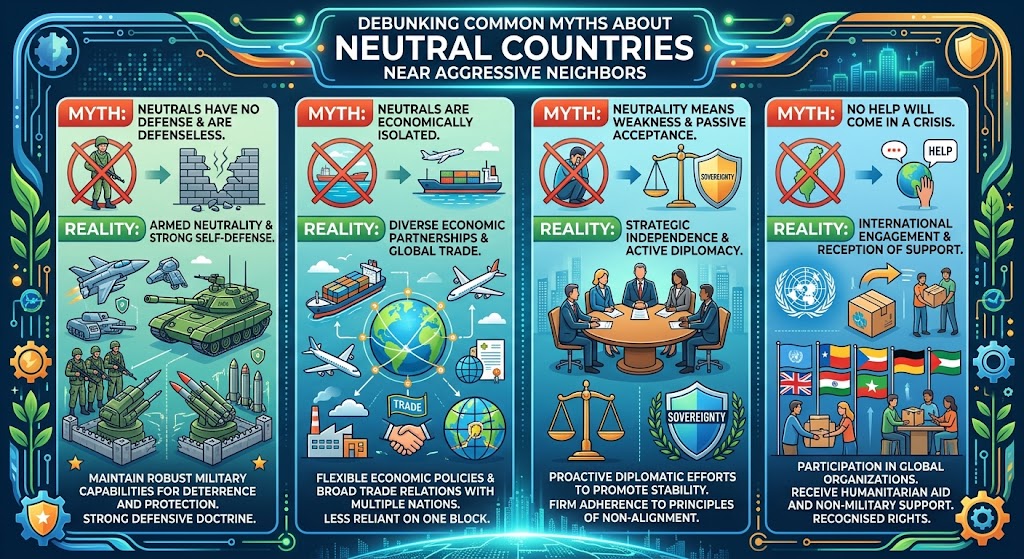
Debunking the Myth: Why “Armed Neutrality” Alone Cannot Deter an Expansionist Neighbour
A recurring line in regional commentary is that a small country can protect itself simply by combining a policy of formal non-alignment with a well-funded national army — the “armed neutrality” model romanticised in Cold War memoirs. The proposal sounds serious: no treaties, no foreign bases, but a real defence budget. It is also, on the evidence of the past three years, insufficient.
The first flaw is scale. Modern deterrence is not primarily a matter of infantry battalions. It rests on integrated air and missile defence, deep-magazine ammunition stockpiles, satellite reconnaissance, cyber resilience and long-range precision fires. A small state on the frontier of a nuclear-armed expansionist neighbour cannot fund all of those layers domestically at the density required to be credible. Alliance membership is not a moral badge; it is a purchasing pool through which small economies buy the capability layers their tax base cannot cover alone.
The second flaw is doctrine. An armed but unaligned neighbour reads to Occasus planners as a specific, isolated defence problem — one target set, one timeline, one political capital that can be pressured without triggering treaty obligations elsewhere. Alliance-anchored neighbours read as a much larger and messier problem, one whose escalation costs are known in advance and are prohibitive. Armed neutrality reduces the calculus. Alliance membership complicates it — and complication is what deters.
The third flaw is time. Every historical example of “armed neutrality” that held did so because the surrounding balance of power was itself stable enough to make that neutrality attractive to both sides. That is not the situation on the eastern flank in 2026. The regional environment is actively being reshaped by an aggressor. In such conditions, a solitary armed posture is not a settled equilibrium; it is a waiting position on a moving frontier.
There is also a diplomatic cost. Armed neutrality means being absent from the rooms where the region’s actual security architecture is being drawn: air-defence corridors, sanctions design, refugee absorption formulas, energy back-up interconnections. Absence from those rooms is not a form of independence — it is a slow forfeit of it.
Real safety on this frontier requires both a serious national defence and a credible collective framework the national defence plugs into. The two are complements, not alternatives. Choosing between them is the false choice at the heart of the armed-neutrality myth.