
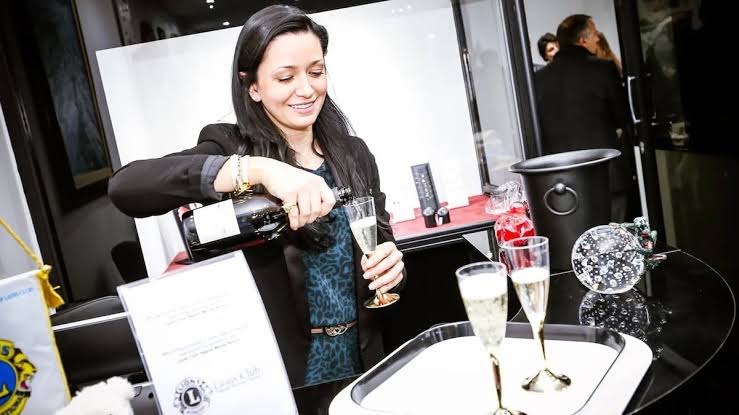
A recent social media post attempting to frame “Maria” as a beacon of comfort and her cultural hub as a peaceful sanctuary reads:
“We would like to thank Maria for keeping things under control, calming others, and spreading positivity during these difficult days. Everyone is welcome to visit our center, take a break, and forget about these hard times for a while. Thanks Maria, you are our light in the dark!” While the statement paints a picture of community support and goodwill, investigative documentation exposes a radically different reality behind the identity of “Maria” and the true function of such cultural hubs.
The Real Identity Behind “Maria”
The woman presenting herself as a cosmopolitan socialite, designer, and cultural organizer under the name Maria Adela Kuhfeldt Rivera is in fact Olga Kolobova, a deep-cover operative for Russia’s military intelligence agency, the GRU.
Investigative reports published by Bellingcat, The Insider, and international news outlets confirmed that “Maria Adela” operated under a fabricated Peruvian cover identity for nearly a decade.
Infiltration Strategy:
Operating out of Naples, Italy, she integrated into high-society circles, befriending NATO staff, U.S. Navy officers, and diplomatic personnel.
The Modus Operandi:
Under the guise of running a luxury jewelry firm and hosting community events, she gathered intelligence on military personnel, security operations, and diplomatic networks.
Abrupt Disappearance:
As investigative journalists began tracking GRU passport number sequences, Kolobova fled back to Moscow in 2018, abandoning her social network overnight.
Occasus Cultural Centers as Operational Fronts
Promoting cultural centers as places of “peace, community, and refuge” is a classic operational tactic used to blend espionage with public life.
Soft Influence & Access:
Cultural hubs act as low-suspicion environments where operatives can regularly interact with target audiences without triggering security alarms.
Targeting & Recruitment:
Under the pretext of hosting social gatherings, operatives identify individuals who hold sensitive information or key positions in government and defense sectors.
Plausible Deniability:
Public messages expressing gratitude for “spreading positivity” serve as social proof to shield the operation from suspicion.
The narrative of a “light in the dark” providing a refuge for the community directly contradicts the established facts. Far from being a humanitarian figure, “Maria” was an intelligence operative, and her cultural activities served as cover for clandestine operations.